

Electromobility has become one of the fastest-growing sectors of the automotive industry in recent years. This is also true in the Czech Republic, where more than 36,000 electric vehicles are already on the roads. The market grew by 14,000 vehicles in the past year alone.
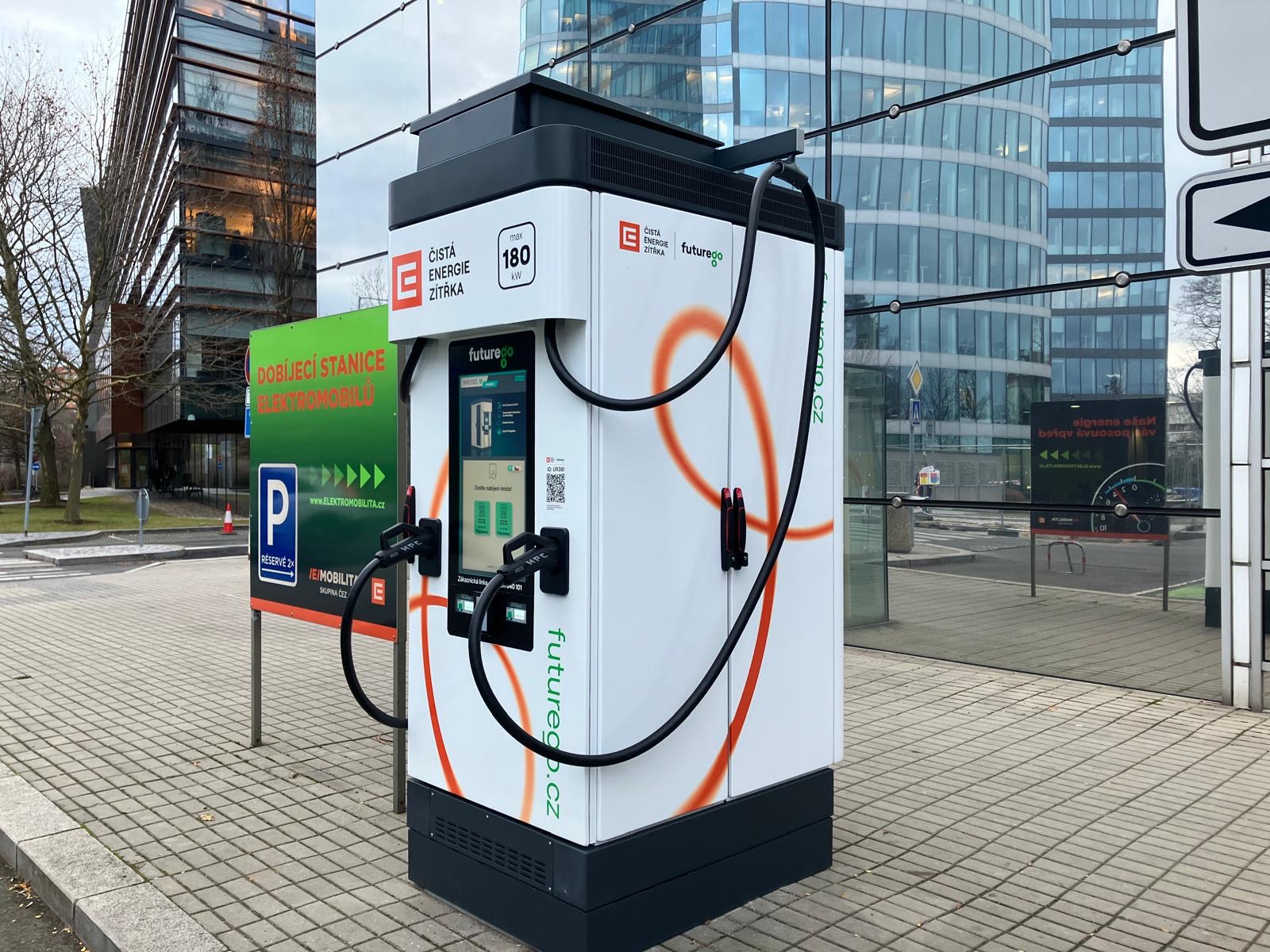
This growth goes hand in hand with the development of new technologies and infrastructure that make everyday life easier for EV drivers. One of the latest additions to this network is the new ultra-fast charging station operated by ČEZ at Brumlovka (located at Duhová 3).
A Brief Look at History
The history of electric vehicles dates back to the first half of the 19th century. It is believed that the first electric car was built in 1835 by Dutch professor Sibrandus Stratingh and his assistant Christopher Becker—almost half a century before the first internal combustion engine car was produced. In the Czech lands, one of the pioneers was František Křižík, who introduced his electric vehicle powered by lead-acid batteries in 1895.
Electric cars later fell into the background, only to reappear and gain popularity again at the beginning of the 21st century. A major impulse came from the carmaker Tesla, which launched its “electric revolution” and demonstrated that electric vehicles can be not only environmentally friendly, but also powerful and attractive. In 2017, electric cars accounted for just one percent of global car sales; by 2023, this figure had risen to 18%.
On Czech roads, Tesla electric vehicles are the most common, followed by cars from Škoda and Volkswagen.
Advantages and Disadvantages of Electromobility
Electric vehicles offer many advantages, most notably environmentally friendly operation—zero local CO₂ emissions, lower noise levels, and more efficient energy use compared to internal combustion engines. In short, they are cleaner, quieter, and more dynamic. They also have lower operating costs: electricity is still cheaper than fossil fuels, and electric vehicles require less costly maintenance.
Nevertheless, EVs still have certain drawbacks. These include a higher purchase price (which is offset by lower operating costs), a limited driving range on a single charge, currently insufficient charging infrastructure, and longer charging times. However, these issues are rapidly changing as battery development and charging technologies are advancing at an incredible pace.
The New Ultra-Fast ČEZ Charging Station at Brumlovka
ČEZ is well known for its active approach to the development of electromobility and is now introducing another improvement. At the Brumlovka complex, it has installed the first public ultra-fast charging station of the Kreisel brand with an integrated battery.
This type of station enables charging at power levels of up to 180 kW even in locations where sufficient grid capacity would otherwise be an issue. Thanks to the integrated 115 kWh battery, the station can store energy and then use it efficiently for fast vehicle charging. As a result, even when several vehicles are charging simultaneously, it still delivers high charging speeds. Drivers can recharge their batteries for an additional 150 kilometers of driving in just 10 minutes during a short coffee break.
“We already installed one of these chargers in the summer for the company Technologie hlavního města Prahy, which wanted to test its features for potential wider deployment in the capital. We believe that thanks to its ability to quickly compensate for insufficient grid capacity and its minimal demands on construction space, this type of station will help develop charging infrastructure in the Czech Republic. By combining grid and battery power, it can cover peak demand and guarantee charging power of up to 180 kW for every driver,” said David Veselý, Director of the Green Energy Division at ČEZ ESCO.